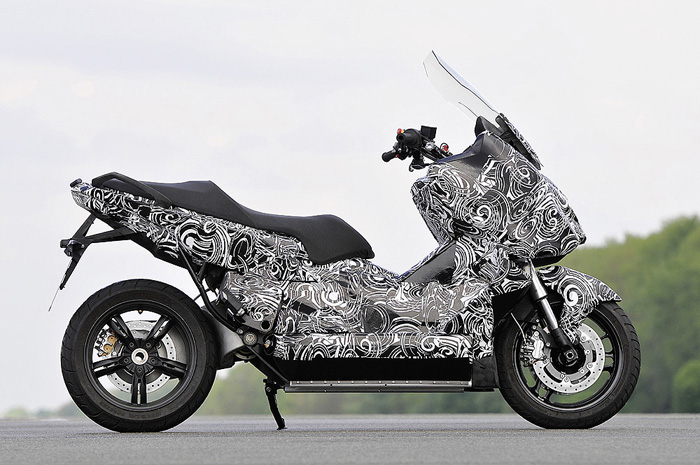
press release(abridged):
Hardly a year has gone by since
the launch of the MINI E, and MINI is at it again, opening up fascinating prospects for urban mobility that reduce CO2 emissions without any compromises on spontaneity and independence. The MINI Scooter E Concept transfers the brand’s hallmark driving fun to the two-wheel segment for the first time. Equally unique features are the link between the scooter’s alternative drive concept and its unmistakable design, intelligent functionality and detailed personalisation options in true MINI style. The MINI Scooter E Concept is powered by an electric motor integrated in the rear wheel.

The motor’s lithium-ion battery can be recharged at any conventional power socket using an on-board charging cable. The concept study, which is being launched as a world premiere at the 2010 Paris Motor Show, meets the mobility aspirations of a target group that sets store by premium quality and advanced technology as well as placing sustainability on a par with individual style and an emotional driving experience. The MINI Scooter E Concept also highlights new ways of attracting in particular a young audience to the MINI brand.
 Typical MINI design – a world first on two wheels.
The MINI Scooter E Concept, making its world debut in two individual design versions, opens up a whole host of options for enjoying the driving fun associated with MINI while at the same time being immediately recognisable as a true ambassador of the brand. This synthesis has been achieved by the systematic transfer of fundamental MINI design principles to the new vehicle concept and through an authentic reinterpretation of unique details. The design language and wealth of individual details embodied in the two-wheel study are based on the current production models of the MINI brand.

Clearly defined proportions and smoothly contoured lines lend the MINI Scooter E Concept an aesthetic appearance that evinces significant parallels to the brand’s cars. The relationship between the size of the wheels and the vehicle as a whole play a significant role here. The 11-inch rims of the MINI Scooter E Concept give the study a powerful and robust appearance, emulating the profile of MINI cars. The alignment of the contours enhances this impression from the side by clearly defining the front and rear of the vehicle before sweeping up towards each other at virtually identical angles. The windshield of the MINI Scooter E Concept is angled in an upright position similar to that of the front windshield in MINI cars. The curvature designed into the sides also displays parallels with the transitions of a windshield in the MINI as it merges into the A-pillars. Round headlights with independent contour, windshield with an aperture in MINI radiator grille style.

The front view of the MINI Scooter E Concept is dominated by a remarkably large, round headlight unit. Similar to the headlights of the MINI Countryman, the headlight contour diverges slightly from the original circular shape, and both designs are influenced by the geometry of the surrounding surfaces. The independent contour of the headlight unit in the MINI Countryman matches the brawny, curved wheel arches and the robust radiator grille, while on the MINI Scooter E Concept it takes its cue from the low-slung windshield. The headlight unit tapers upwards and features a chrome surround, creating a strong profile in characteristic MINI style. The circular shape of the main headlight interior is highlighted by an illuminated coloured ring.

Projecting indicators, meanwhile, invoke the front view of the classic Mini. The glass covers for the flasher lamps are enclosed in chrome fames and curve slightly outwards to resemble the historic profile.

A stylised aperture in the windshield configured below the headlight contributes to the front profile so typical of the brand, its shape mimicking the contour of the hexagonal radiator grille in MINI cars. This design element also has a chrome frame, while the impression of familiarity is further enhanced by the MINI brand logo above it. The windshield itself is framed by a wraparound plastic surround. Each of the two study versions also has individually matched paintwork for the windshield, wheel covers and fairing enclosing the frame. A contrasting colour is applied to the surface of each of the windshields, and the range of hues in the paintwork reflects the light and shade effects on the curved engine bonnet of a MINI four-wheeler.
Inimitably MINI: chrome elements, round mirrors and two upright tail lights.
Other chrome elements are evident on the hand grip at the back of the seat and on the footrest. The hand grip is shaped like the rear spoiler of the MINI Cooper S, while a continuous band of chrome positioned directly below the seat recalls the side sill on MINI cars.
The rear-view mirrors on the MINI Scooter E Concept likewise display familiar characteristics in their shape and their size in proportion to the vehicle. This applies to the round contour of the mirror surfaces, the eye-catching volume of the hemispherical casing, as well as the different mirror cap designs that permit additional individualisation options.

Another characteristic design feature is reinterpreted at the rear of the MINI Scooter E Concept: the two tail light units are mounted on the outside of the rear wheel fairing in an upright position. A transparent glass cover recalls the MINI Countryman and provides a view of the three-dimensional structure of the tail lights, brake lights and indicators. Each of the tail light units on the MINI Scooter E Concept is mounted in a chrome frame and the MINI logo is positioned between the tail lights.
One concept, two characters.
The exceptional potential of the new mobility concept is underscored by the parallel presentation of two design concepts. These two versions highlight the key features of the study – driving fun, sustainability, sportiness and lifestyle orientation – with an individual focus. The concepts have different functionalities in terms of the number of seats: the MINI Scooter E Concept is presented in a version developed to support driving fun for two people and in an emphatically sporty, thoroughbred version with a seat designed for the rider alone.

The colour design of the two-seater version of the MINI Scooter E Concept is based on the appearance of the MINI E, which highlights its emission-free drive concept in a particularly striking way. The livery designed in matt anthracite creates an attractive contrast with the seat finished in yellow, with the iridescent colour of the windshield around the headlight unit and the yellow mirror caps providing further accentuating features. The surface of the seat is made of tough fabric material, with a yellow strip bordering the lower part of the seat.


In each of the two versions of the MINI Scooter E Concept, this strip sweeps downwards from the front of the seat into the frame fairing and continues along the edge of the footrest towards the front, where it also runs around the windshield. This creates a visual boundary between the body of the scooter and the rider/passenger area including the foot space and cockpit.
The design of the second version of the MINI Scooter E Concept is steeped in the brand’s heritage and British origins. Primarily designed for solo riders, this version represents the sportier version of the new vehicle concept. Its British Racing Green finish harks back to classic racing cars, with the sparkle of the paintwork lending a particularly distinguished, high-quality aura to this new interpretation.


The seat is upholstered in dark brown leather and the surface has an artifically created “used look”. Attractive contrasts to the dark-green body colour are provided by silver mirror caps and paintwork around the headlight unit in the windshield that flips between green and silver.
Progressive, stylish, uncomplicated operation.The MINI Scooter E Concept is a rallying call for spontaneous riding enjoyment. This is fostered by intuitive operation and agile ride characteristics. Thoroughbred mobility in hallmark MINI style entails vehicle handling that is completely intuitive and needs no further explanation. That applies to the immediate activity of riding as well as charging the lithium-ion battery. The operating concept is also directed towards enabling straightforward and effortless use of the other functions designed to enhance driving fun.

This challenge is met by an innovative way of integrating mobile devices. The cockpit of the MINI Scooter E Concept comprises a Centre Speedo in the circular shape familiar from MINI, with a smartphone integrated in the middle. The wraparound speedometer is in the form of a tube filled with fluid, the content expanding in line with the speed rather like a thermometer. In the lower area of the Centre Speedo, a battery charge level display indicates the range currently available. The design of all the control elements for lights, direction indicators and other driving functions corresponds to the buttons on the multifunction steering wheel of MINI cars.
Smartphones as key, display and central control element.
The inside of the round instrument comprises a snap-in adapter for a smartphone, which operates simultaneously as the vehicle key, display and central control element. As soon as the rider docks his mobile phone and switches it on, the vehicle is ready to go. This configuration in the MINI Scooter E Concept yields new initiatives for integrating infotainment, communication and navigation functions in a two-wheeler. While the scooter is in motion, the smartphone can be used as a navigation system, music player or telephone as required. A wireless Bluetooth interface can be connected to a helmet from the MINI Collection. This is fitted with a microphone and headphones so that riders are able to use the telephone function or access their personal music collection while on the road.

The innovative operating concept creates a network between the rider, the vehicle and the environment which paves the way for numerous new interactive functions. Building on the MINI Connected services already available in current MINI production cars, specific features can be implemented by adding further smartphone applications. For example, the navigation function can be supplemented by a special map view in Google Maps which indicates the current position of other scooters from the brand in the immediate vicinity. This provides a feature similar to social networks on the internet where riders who are friends can be identified and invited to come together on a whim by simply pressing a button. A greeting function has also been developed for the MINI Scooter E Concept to further strengthen the community appeal and highlight the friendly and open-minded personality of this vehicle. An automated full-beam headlight function that operates when two vehicles meet strengthens this sense of community.
MINI Centre Rail in an innovative design and with specific accessories.
Alongside the intuitive control and interactive functions, the advanced functionality of the MINI Scooter E Concept also contributes to its intuitive and compelling operation. Two compartments on the inside of the windshield are available for stowing personal items. The study also incorporates an innovative aluminium design of the MINI Centre Rail first presented in the MINI Countryman. The mounting rail configured inside the windshield extends downwards into the foot space, and the unique clip-on mechanism offers a range of options for transporting items that are required during the journey or at the rider’s destination. These items are stored so that they easily come to hand.
Dedicated Centre Rail specifications are offered for each version of the concept. The universal mounting system means that they can be switched between vehicles at any time or complemented by other products from the MINI Accessories range for the MINI Countryman. The accessories for the Centre Rail include tailor-made holders from the MINI Collection for the helmet as well as for umbrellas, sunglasses and thermos flasks. An additional closed compartment and an expanded rain guard to protect the rider’s legs can also be easily connected to the Centre Rail. A music player, calendar, stopwatch and tea cups specially designed for the MINI Scooter E Concept can also be attached to the Centre Rail.
All you need is a power socket: maximum independence guaranteed by an integrated charging cable.
When riding the MINI Scooter E Concept, brief stops can be used to top up the on-board energy storage system. Consistent charging significantly increases independence and flexibility when using the electrically powered two-wheeler. The electric drive unit, concealed beneath a painted cover inside the rear wheel, is powered by electricity supplied from a lithium-ion battery. Apart from the compact battery, a charging system and connecting cable are integrated snugly in the rear of the MINI Scooter E Concept. The charging cable has a plug which fits into any conventional domestic socket. This has the major advantage that topping up the energy reserve does not depend on a special charging station being available. Stop-offs for shopping or visiting a café can be used for hassle-free battery recharging.
Plugs and cables are accommodated underneath a cover similar to the round tank flap in a MINI car. After opening the illuminated flap, the plug and charging cable can be pulled out to a length of up to five metres and connected to the power system. After the battery has been charged up, a button-operated spring mechanism ensures that the cable is retracted and coiled in a space-saving compartment.
all images and information courtesy of MINI